
Tennis drills are essential for skill development, offering structured practice for beginners. Printable PDF formats provide convenient, accessible training plans for consistent improvement on and off the court.
Why Drills are Crucial for New Players
Tennis drills are fundamentally important for new players because they break down complex skills into manageable components. Starting tennis can be overwhelming, with numerous techniques to learn – grips, footwork, serves, and volleys. Drills provide a focused approach, allowing beginners to master each element progressively.
Consistent practice through drills builds muscle memory and reinforces correct technique, preventing the development of bad habits. Utilizing PDF formatted drills offers a structured learning path, ensuring no crucial aspect is overlooked. These resources often include step-by-step instructions and visual aids, making them incredibly accessible;
Furthermore, drills help build confidence by providing achievable goals and measurable progress, reducing frustration and fostering a positive learning experience. They transition players from simply hitting the ball to strategically playing the game.
The Importance of a PDF Format for Drills
PDF formats are exceptionally valuable for tennis drills because they offer portability and accessibility. Players can easily download and print drills for use on or off the court, eliminating the need for constant internet access. This is particularly useful for outdoor practice sessions or travel.
A well-structured PDF drill guide typically includes clear instructions, diagrams, and even progressive exercises, catering to different skill levels. They provide a consistent and reliable resource, ensuring players follow the correct techniques. Online sources offer a wealth of beginner tennis drills in this convenient format.
Moreover, PDFs allow for customization; coaches or players can annotate drills, track progress, and create personalized training plans. This adaptability makes them a superior choice compared to fleeting online content.

Fundamental Tennis Skills to Practice
Tennis fundamentals – grips, footwork, forehands, and backhands – are crucial for beginners. PDF drill resources effectively build these core skills for consistent progress.
Grips: Continental, Eastern, Semi-Western
Mastering tennis grips is foundational for beginners, directly impacting stroke production and control. The Continental grip, versatile for serves and volleys, requires practice to develop feel. Eastern grips, common for forehands, offer a balance of power and spin.
Semi-Western grips, increasingly popular, facilitate topspin generation, crucial for modern tennis. PDF drill resources often dedicate sections to grip development, utilizing visual aids and step-by-step instructions. Beginners should focus on consistently adopting the correct grip before progressing to more complex drills;
Drills focusing on grip changes – transitioning between grips during rallies – enhance adaptability. Consistent practice, guided by PDF materials, builds muscle memory and ensures proper technique, laying a solid foundation for future skill development; Understanding these grips is vital for success.
Footwork: The Foundation of Movement
Effective footwork is paramount in tennis, enabling players to reach the ball efficiently and maintain balance. Beginners often overlook this crucial aspect, focusing solely on stroke mechanics. PDF tennis drill guides emphasize agility and quickness drills, like shuffling and split-stepping, to improve court coverage.
These drills build the necessary muscle memory for reactive movement. PDF resources often include diagrams illustrating proper footwork patterns for various shots. Practicing footwork independently, without hitting balls, is highly beneficial.
Developing a consistent split-step just before the opponent’s contact is key. Footwork drills, readily available in PDF format, should be incorporated into every practice session, forming the bedrock of a solid tennis game and enhancing overall performance.
Basic Strokes: Forehand and Backhand
Mastering the forehand and backhand are fundamental to tennis success. PDF tennis drills for beginners typically start with simple feeding exercises, focusing on proper grip, swing path, and contact point. These drills build a solid foundation before introducing more complex scenarios.
PDF guides often break down the strokes into manageable steps, with visual aids demonstrating correct technique. Consistency is key; drills emphasize hitting with control rather than power initially.
Beginners should practice both one-handed and two-handed backhands to determine their preference. PDF resources provide drills for both styles, highlighting the advantages and disadvantages of each. Regular practice using these PDF-based drills will build muscle memory and improve stroke reliability.
Warm-up Drills
PDF warm-up routines for tennis beginners include dynamic stretching and light cardio, preparing muscles for activity and preventing injuries during drills.
Dynamic Stretching for Tennis
Dynamic stretching is crucial before tennis drills, preparing muscles for the specific movements required in the sport. Unlike static stretching, which involves holding a stretch, dynamic stretches involve controlled movements through a full range of motion.
A PDF guide for beginners should include exercises like leg swings (forward, backward, and sideways), arm circles, torso twists, and high knees. These movements increase blood flow, improve flexibility, and enhance muscle activation. Performing these stretches before hitting the court can significantly reduce the risk of injury and improve performance.
Focus on controlled, fluid motions, avoiding bouncing or jerky movements. Each stretch should be performed for approximately 10-15 repetitions. Remember, the goal is to warm up the muscles, not to achieve maximum stretch.
Light Cardio and Coordination Exercises
Before diving into specific tennis drills, a PDF for beginners should incorporate light cardio and coordination exercises. These prepare the body and mind for more intense activity, enhancing agility and responsiveness on the court.
Simple exercises like jogging in place, jumping jacks, and high knees are excellent for raising the heart rate and warming up the muscles. Coordination drills, such as cone drills or ladder drills, improve footwork and reaction time – fundamental skills in tennis.
These exercises should be performed for 5-10 minutes, focusing on maintaining a moderate intensity. They help adjust the boring routine and build a solid technical foundation for higher levels of play.

Forehand Drills
Forehand drills, often found in beginner tennis drills PDF guides, focus on groundstroke consistency, crosscourt accuracy, and down-the-line precision for effective play.
Forehand Groundstroke Feeding Drills
Forehand groundstroke feeding drills, commonly detailed in tennis drills PDF resources for beginners, are foundational for developing proper technique. A coach or partner gently feeds balls to the player, allowing them to focus on swing path, contact point, and follow-through.
These drills start with slow, consistent feeds, gradually increasing the pace and varying the ball’s location. The goal isn’t power initially, but rather repetition and building muscle memory. Beginner PDF guides often suggest starting close to the net and progressively moving back as the player gains confidence.
Focus should be on maintaining a balanced stance, proper grip, and a smooth, controlled swing. Variations include feeding to the forehand side only, then alternating sides to improve reaction time and adaptability. Consistent practice with these drills builds a solid base for more advanced forehand techniques.
Forehand Crosscourt Consistency Drill
The forehand crosscourt consistency drill, frequently found in tennis drills PDF guides for beginners, emphasizes accuracy and control over power. Players rally crosscourt, focusing on landing the ball deep within the opponent’s court consistently. This drill builds stamina and reinforces a reliable crosscourt shot.
Beginner PDF resources often recommend starting with a slow, controlled pace, prioritizing getting the ball in over hitting it hard. The aim is to develop a repeatable swing and consistent contact. Players should focus on maintaining a stable base and a smooth follow-through.
As proficiency increases, the pace can be gradually increased, and targets can be introduced to enhance accuracy. This drill is crucial for developing a dependable crosscourt shot, a cornerstone of strategic tennis play.
Forehand Down-the-Line Accuracy Drill
The forehand down-the-line accuracy drill, commonly detailed in tennis drills PDF resources for beginners, focuses on precision and directional control. Players aim to hit forehands directly down the line, emphasizing a straight swing path and targeted contact. This drill builds confidence in hitting with intent.
Many beginner PDF guides suggest starting with a stationary feed, allowing players to concentrate solely on their technique and target. Visualizing the target line and maintaining a focused gaze are key components. Emphasis is placed on a compact swing and solid contact point.
Progressively, the drill can incorporate movement and varied feeds, increasing the challenge. Mastering this drill improves a player’s ability to dictate play and open up the court.

Backhand Drills
Backhand drills, often found in tennis drills PDF guides, help develop consistency and power. Practice both one-handed and two-handed techniques for optimal court coverage.
Backhand Groundstroke Feeding Drills
Backhand groundstroke feeding drills, commonly detailed in tennis drills PDF resources, are foundational for beginners. A coach or partner gently feeds balls to the player’s backhand side, allowing focus on proper technique without chasing shots.
Start with slow, consistent feeds, emphasizing a stable stance, correct grip, and a smooth swing path. Gradually increase the feed speed and vary the ball’s depth and angle. These drills build muscle memory and improve consistency.
Beginners should concentrate on contacting the ball out in front of their body and following through towards the target. PDF guides often include diagrams illustrating proper form. Repetition is key; aim for controlled swings rather than powerful hits initially. This drill establishes a solid base for more advanced backhand play.
One-Handed vs. Two-Handed Backhand Practice
Tennis drills PDF guides often address the choice between one-handed and two-handed backhands. Beginners frequently experiment with both to determine which feels more natural and provides greater control. Practice drills should isolate each technique.
For the one-handed backhand, focus on shoulder turn, wrist snap, and extending through the ball. Two-handed drills emphasize using the non-dominant hand for power and stability. Consistent feeding drills, as found in many PDF resources, are crucial.
Compare the results – which stroke yields more consistent contact and depth? Consider physical attributes; two-handed backhands generally offer more power, while one-handed allows greater reach. Ultimately, the best choice depends on individual preference and comfort, honed through dedicated practice.

Serving Drills
Tennis drills PDF resources emphasize basic technique and target practice. Mastering the serve requires consistent repetition, focusing on form and placement for accuracy.
Basic Serve Technique Practice
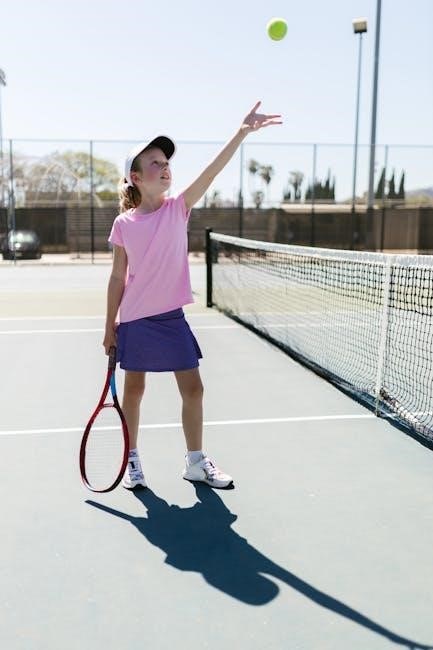
Beginner tennis drills PDF guides often start with foundational serve practice; Focus initially on the grip, stance, and the tossing motion – ensuring a consistent ball toss is paramount. Drills should emphasize a smooth, fluid motion, prioritizing form over power.
Many resources recommend practicing the serving motion without a ball to build muscle memory. Then, progress to hitting serves into the service box, concentrating on landing the ball within the designated area.
PDFs frequently include drills for practicing the full serving motion, breaking it down into stages: the toss, the backswing, the forward swing, and the follow-through. Consistent repetition, guided by a tennis drills PDF, will build confidence and accuracy, establishing a solid serving base.
Target Practice for Serve Placement
Once a basic serve is established, tennis drills PDF resources introduce target practice. This involves setting up visual targets within the service boxes – cones, towels, or even lines drawn with chalk – to improve accuracy. Beginners should start by aiming for a larger target area and gradually decrease the size as their consistency improves.
Drills often involve serving to different targets in a sequence, forcing players to adjust their aim and control. A PDF might suggest serving five balls to the deuce court, then five to the ad court, focusing on hitting the designated targets each time.
These targeted drills build precision and strategic thinking, moving beyond simply getting the serve in to placing it effectively, setting up advantageous points.

Volley Drills
Tennis drills PDF guides introduce volleying with reaction-time exercises and approach-and-volley basics, building net play skills for beginners through focused practice.
Volley Reaction Time Drills
Volley reaction time drills, often found within beginner tennis drills PDF resources, are crucial for developing quick reflexes at the net. These drills typically involve a coach or partner feeding balls from close range with varying speeds and directions. The player focuses on reacting swiftly to the incoming ball, blocking it back over the net with a firm, compact volley stroke.
Beginners should start with stationary volleys, gradually increasing movement as their reaction time improves. A common drill involves the feeder standing a few feet away, hitting balls directly at the player’s chest. Progression includes wider feeds, lower balls, and incorporating split-step timing. Printable PDF guides often illustrate proper technique and drill variations, ensuring effective practice and faster skill acquisition.
Approach and volley drills, often detailed in tennis drills PDF guides for beginners, introduce the fundamental skill of moving forward to finish points at the net. These drills begin with simple approaches – hitting a groundstroke and then taking a few steps forward. The focus is on maintaining balance and preparing for the volley.
Initially, players practice hitting a short, controlled volley after the approach. More advanced drills involve the feeder hitting a deeper ball, requiring a more aggressive approach and a quicker reaction volley. Printable PDF resources often emphasize the importance of the split-step as the opponent strikes the ball, enabling a faster first step towards the net. Mastering this combination is key to effective net play.

Cool-down and Flexibility
Cool-down routines, often found in tennis drills PDF guides, are vital for muscle recovery and preventing injuries after intense practice sessions on the court.
Static Stretching for Muscle Recovery
Static stretching is a crucial component of any post-drill cool-down, and many beginner tennis drills PDF resources emphasize its importance. Unlike dynamic stretches used in warm-ups, static stretches involve holding a stretch for a sustained period, typically 20-30 seconds. This allows muscles to lengthen and recover, reducing soreness and improving flexibility.
Focus on major muscle groups used in tennis – shoulders, arms, back, legs, and core. Examples include hamstring stretches, quad stretches, calf stretches, triceps stretches, and shoulder stretches. Proper form is essential to avoid injury; stretches should be gentle and never cause pain. Regularly incorporating static stretching, as outlined in PDF guides, will contribute to long-term athletic performance and injury prevention.
Importance of Post-Drill Cool-down
A post-drill cool-down is often overlooked, yet it’s vital for recovery and preventing injury, frequently detailed within beginner tennis drills PDF guides. It allows the body to gradually return to a resting state, preventing muscle stiffness and soreness. Skipping a cool-down can lead to decreased flexibility and increased risk of strains.
Effective cool-downs typically involve light cardio, such as a slow jog or walk, followed by static stretching. This combination helps remove lactic acid buildup and restore muscle length. Many PDF resources suggest a 5-10 minute cool-down period. Prioritizing a cool-down demonstrates commitment to long-term physical well-being and consistent improvement in tennis performance.
Resources for Printable Tennis Drills (PDFs)
Tennis drills PDF resources are widely available online, offering structured training plans for beginners. Explore websites and coaching materials for downloadable practice sessions.
Online Sources for Beginner Tennis Drills
Numerous websites offer free and premium tennis drills in PDF format, specifically designed for beginners. Searching for “beginner tennis drills PDF” yields a wealth of resources, including coaching session planners and skill-building exercises.
Many tennis clubs and organizations publish downloadable drill collections on their websites. These often categorize drills by skill – forehand, backhand, serving, and volley – making it easy to target specific areas for improvement.
YouTube channels dedicated to tennis instruction frequently link to accompanying PDF drill sheets in their video descriptions. Platforms like Tennis TV and Feel Tennis provide valuable content and supplementary materials. Additionally, online marketplaces sometimes host professionally created drill books in PDF format for purchase, offering more comprehensive training programs.
Creating Your Own Tennis Drill PDF
Personalizing your tennis drill PDF allows tailoring practice to individual needs and skill levels. Start by outlining specific goals – improving forehand consistency, serve accuracy, or footwork speed. Then, detail each drill with clear instructions, including setup, execution, and variations for progression.
Utilize word processing software or dedicated design tools to format your drills logically. Include diagrams or images to illustrate proper technique. Consider incorporating sections for warm-up and cool-down routines.

Save your document as a PDF to ensure consistent formatting across devices. Regularly review and update your drill sheet based on progress and new learning. This customized approach maximizes training effectiveness and fosters a deeper understanding of the game.